

Standing Together: SWC Joins Unifor's Intimate Partner Violence Symposium
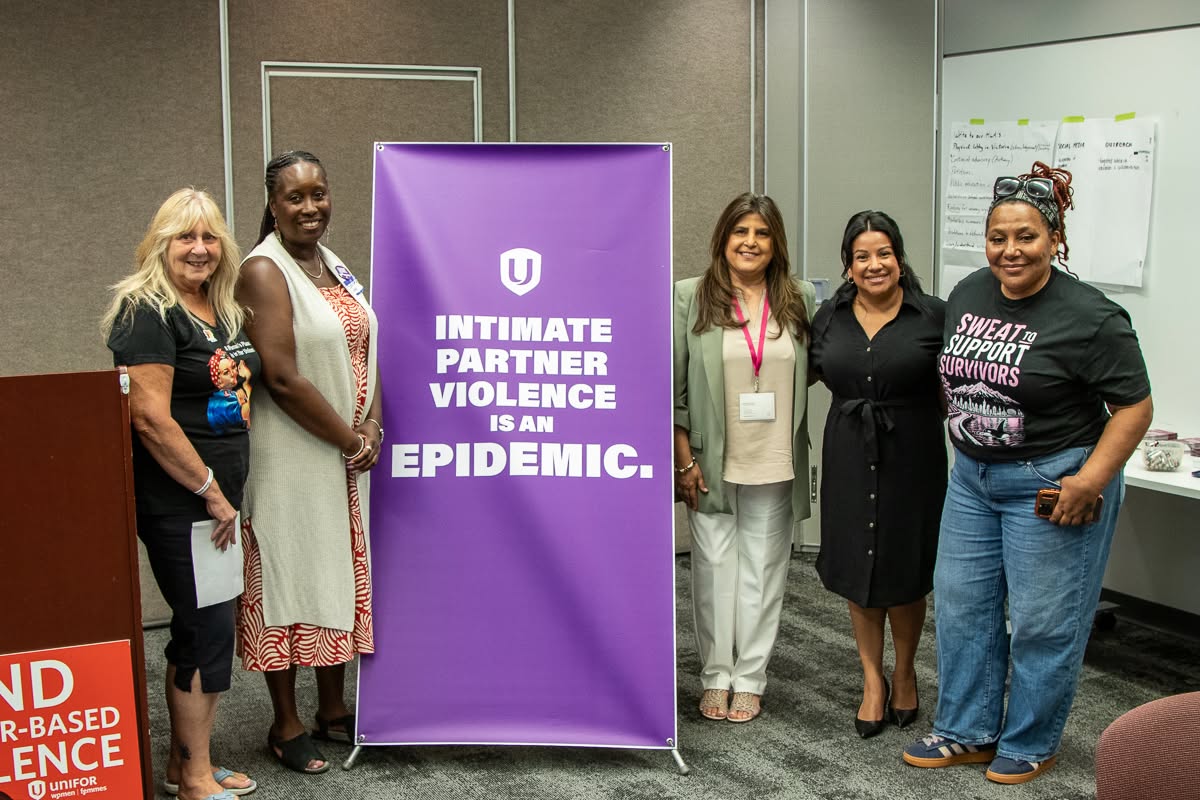
On June 24, our Executive Director, Shahnaz Rahman and Fundraising and Communications Lead, Alexandra Kilian, travelled to New Westminster to take part in Unifor’s Intimate Partner Violence Symposium. Organized by Unifor Women’s Department and the BC Regional Women’s Committee, this full-day event brought together labour leaders, union members, frontline anti-violence organizations, survivors, and community partners to talk honestly about what it will take to declare gender-based violence an epidemic in every province and eradicate it.
A day built for learning, not just listening
After a land acknowledgement, remarks from Gavin McGarrigle, Unifor Western Regional Director, and Tracey Ramsey, Unifor Women’s Director, set the tone for a day that treated intimate partner violence as exactly what it is: a public safety issue, a workplace issue, a community issue, and a systemic one.
The morning’s IPV Workshop, led by Sybil Joseph of the BC Regional Women’s Committee and Gwen Campbell of Unifor’s Women’s Department, walked participants through core statistics and the different forms abuse can take—not as an abstract lecture, but as a working session. We appreciated getting to grips with that material alongside peer organizations including the Ending Violence Association of BC, Shelter Movers, and the Houssian Foundation. Comparing notes and perspectives with a funder, a direct-service society, and a province-wide coordinating body in the same breakout gave the exercises a texture that a slide deck alone couldn’t.
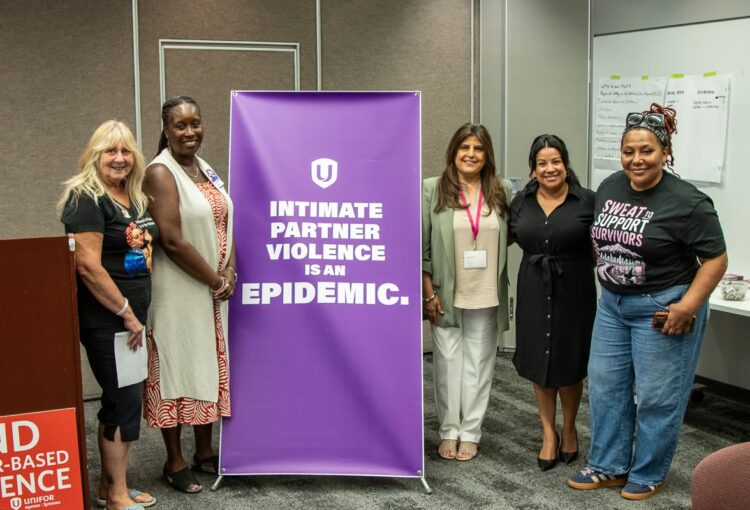 Unifor team along with panelists Shahnaz Rahman, Emmy Skates, and Angela Marie MacDougall
Shahnaz was honoured to join a panel discussion alongside Angela Marie MacDougall, Executive Director of Battered Women’s Support Services, and Emmy Skates, CEO of SARA for Women. Sharing the table with two organizations we’ve long considered peers and collaborators made for a rich conversation about our experiences walking alongside survivors, where the gaps in systems and funding still sit, and how community-based services and organized labour can work together to move the needle.
The afternoon began with Gena Edwards, President of the BC Native Women’s Association and survivor, leading us through the historical and current realities of why Indigenous women, girls, and gender-diverse people are still so disproportionately affected by violence, included commitments from BC Minister of Labour Jennifer Whiteside, and closed with author and survivor Kamal Dhillon, whose story is a reminder of why we were all there and do what we do. The day wound down with a soundbath led by Priscilla Mai, a small but thoughtful acknowledgment that a day spent immersed in this subject matter asks something of everyone in the room.
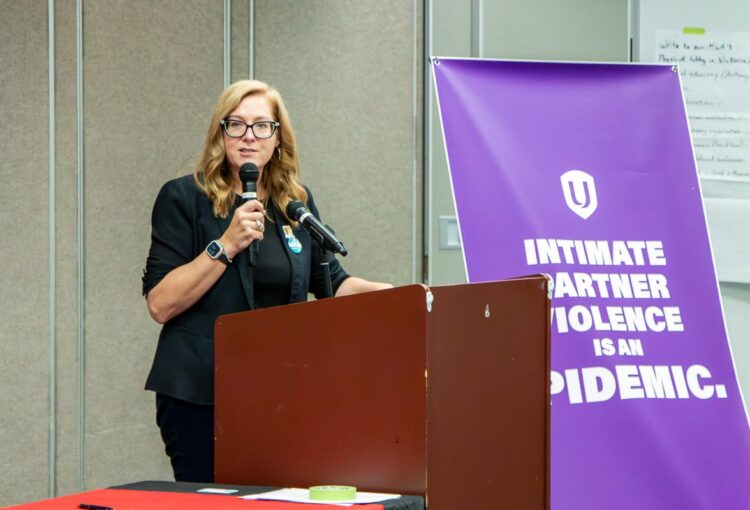 Tracey Ramsey, Unifor Women’s Director
The reports on the table
Part of what made the workshop and discussions substantive was the research participants were equipped with.
The Cost of Inaction: Measuring the Economic Impact of Gender-Based Violence in BC, published by YWCA BC with support from funders including the Houssian Foundation, puts a dollar figure on what governments and communities lose by continuing to under-invest in prevention and response.
Dr. Kim Stanton’s Independent Systemic Review, The British Columbia Legal System’s Treatment of Intimate Partner Violence and Sexual Violence, was released as a final report in June 2025. SWC is proud to have contributed to this review, which put forward a 21-recommendation roadmap for closing the gaps survivors face across the legal system, from policing through to the courts.
 Alexandra Kilian (right) participates in the IPV workshop
Accountability was a key theme of the report and its fall 2025 update, and clearly top of mind for everyone present, along with the awareness that political will is the only real obstacle to the level of coordination and action required to end IPV. Women and Gender Equality’s (WAGE) subsequent announcement of $607.4 million to advance the next phase of the National Action Plan to End Gender-Based Violence is certainly welcome, though how this funding will be distributed remains in question.
Attendees were also supplied with the Mass Casualty Commission’s final recommendations from the inquiry into the April 2020 Nova Scotia tragedy, and to Luke’s Place’s reflections after one year of the National Action Plan to End Gender-Based Violence: both of which echo the need for a national accountability framework that will monitor and evaluate the plan’s progress.
 Gena Edwards of the BC Native Women’s Association
Thank you, Unifor
None of this happens without the people who pull us together. Thank you to Gavin McGarrigle and Tracey Ramsey for their continued advocacy on gender-based violence within the labour movement and on political stages across the country, and to the entire Unifor team for convening this symposium. A special thank you to Gwen Campbell and Sybil Joseph, whose facilitation carried the day and made space for honest and considered dialogue.
We left New Westminster with valued connections and a renewed sense that ending intimate partner violence takes exactly this kind of coalition: unions, community organizations, funders, survivors, and government all pulling in the same direction. We’re grateful to have been part of it, and we’re looking forward to continuing the conversation with our new and existing partners in the months ahead.
